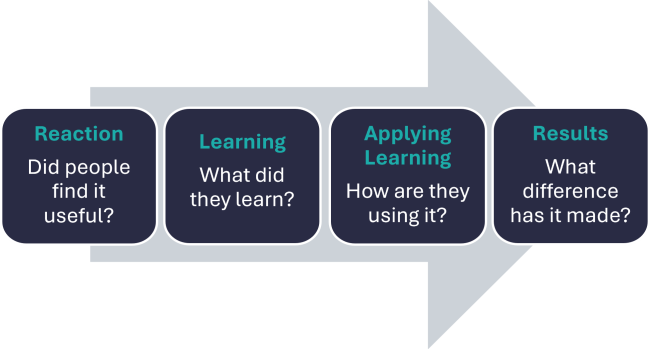
Understanding participant experience helps us assess whether the intervention was engaging, relevant and useful to their role. Positive feedback alone does not demonstrate impact, but it provides valuable insight into the quality of the experience.
Evidence may include:
- Participant feedback forms
- Surveys and evaluations
- Levels of engagement
- Perceived relevance to role
- Satisfaction with delivery and content
- Suggestions for improvement
Understanding participant experience helps us assess whether the intervention was engaging, relevant and useful to their role. Positive feedback alone does not demonstrate impact, but it provides valuable insight into the quality of the experience.
Evidence may include:
- Participant feedback forms
- Surveys and evaluations
- Levels of engagement
- Perceived relevance to role
- Satisfaction with delivery and content
- Suggestions for improvement
What knowledge, skills or confidence have people gained?
This level explores whether participants have developed the understanding, skills and confidence needed to perform effectively. Learning is about readiness to apply knowledge, not just attending training.
Evidence may include:
- Pre and post-training baseline assessments/ feedback, facilitated discussion looking at;
- Knowledge: what participants know and understand
- Skill: what they can do or demonstrate
- Attitude: whether they believe the behaviour is worthwhile
- Confidence: whether they believe they can perform successfully on the job
- Commitment: whether they intend to apply what they learned
Learning only creates value when it is used in practice. We look for evidence that new knowledge, skills and approaches are being applied and supported within the workplace.
Evidence may include:
- Management observations and reviews
- Case studies demonstrating impact
- Personal reflections and statements
- Customer, service user or partner feedback
- Examples of changed practice
- Supervision, coaching and audit findings
At the beginning we need to question, what difference do we want this to make? What is our objective of using Cornerstone VR?
This level focuses on the outcomes that matter most. Rather than looking for a single cause, we consider how the intervention has contributed to wider organisational goals and priorities.
Evidence may include:
- Organisational outcomes and impact measures such as KPIs
- Management overview and strategic reporting
- Strategic changes and service improvements
- Team performance and ways of working
- Individual performance improvements
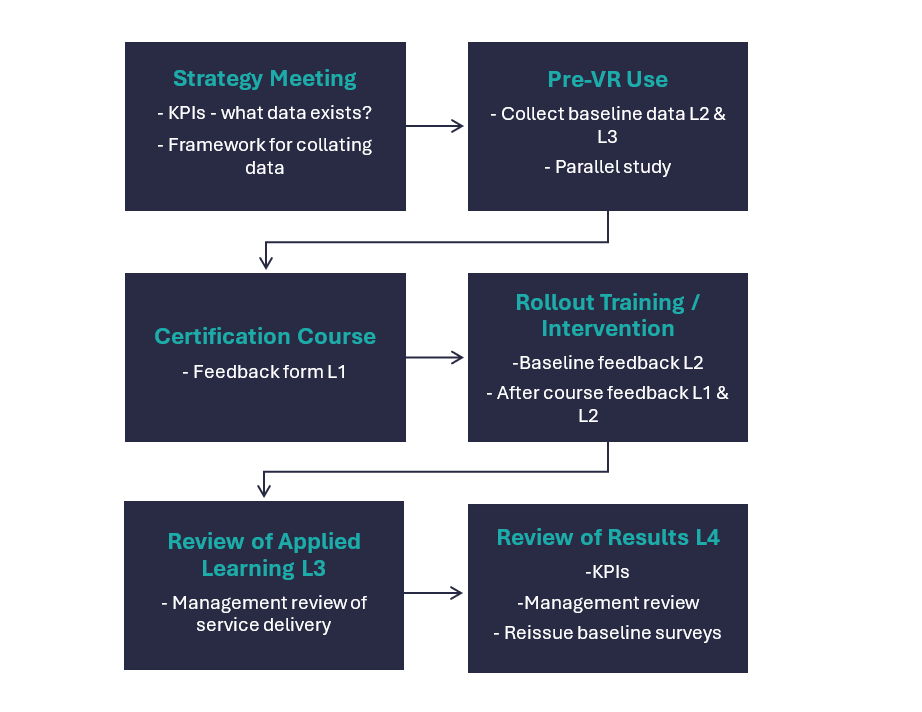
The links below provide template forms that can be used to collect evaluations.
Before collecting any responses, please create your own copy of each Microsoft Form by selecting the three dots (…) in the top-right corner and choosing Duplicate. Once copied, you may rename and adapt the forms to suit your requirements.
When ready, use your customised versions to collect and manage evaluation responses.